Our time here in London seems to be drawing
to a close. We only teach for about 5 more weeks, take a little time off for
the Jubilee and then, Deo Volente, hop a plane for home sweet home. Our list of
things we can’t wait to do when we’re back is growing by the day.
Of course, this all means we have to get
through our list of things we can only do in London rather quickly. The number
of weekends we have free is painfully inadequate to see and experience
everything people have told us to and that we’ve wanted to. But, in the spirit
of getting through as much as we can, we’ve decided to - as much as possible -
get out and be touristy just about each chance we get.
Last Saturday’s manifestation of this
impulse was a trip to see the Tower of London. Now, I did something very
foolish this time; I forgot my camera at home. None of the pictures you are
about to see are mine; they’re courtesy of Google Image search and I deeply
hope I’m not violating any really important copyright law by republishing them
here.
Also, I’m writing now, not only because it
was only yesterday someone recommended I write a blog entry in spite of the
absence of authentic photos, but also because I’m home sick. You can chalk up
any longish pauses between sentences to orange juice and kleenex breaks.
For most North Americans, the Tower of
London is something you feel like you’ve heard of but you don’t really know
very much about it. Many people connect it with prisoners and torture, which is
certainly the main selling feature. For centuries, important political
prisoners and more than a couple big famous people were imprisoned and/or
executed here.
The first misnomer, though, is to call it a
tower. When I hear “tower”, I think one solid high structure. Not a multi-building
complex enclosed by walls that looks a bit like this:
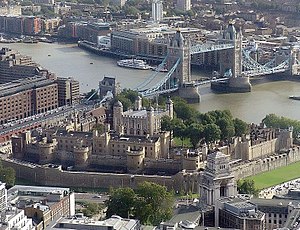
When I see something like that, I think “castle”
or “fortress”. I think both would be good ways to describe the “Tower”.
Of course, the name comes, I think, from the first component that was ever there, built by the Norman William the Conqueror when he became King of England in the 1060s. He built a ring of larger castles outside London to control it, but put a fortified royal palace, the White Tower, right on the edge of it overlooking the Thames

Today, the White Tower is home to some really cool winding stone staircases straight out of the movies as well as one of the world's best Medieval armor and weapons collections. Highlights included a full suit of armour for a small child (think 3 years old; that's how big it was) right next to the largest suit of armour on Earth; more than 7 ft tall. Also, a couple cool interactive exhibits where you get to see how bad the peripheral vision in a helmet was and how heavy a matchlock musket is to lift. I think they might have been for the kids, but Alyssa just kind of smiled while I tried them out.
For me, though, the big highlight was the guided Beefeater tour. The Beefeaters are a real life military order in the British Armed Forces (though their real name is Yeoman Warders)

Most of them are veteran servicemen and war heroes, mainly from the army. But they're not retired. Every now and again, Yeoman Warders get taken off tour guide duty and put into combat situations. Not often, I don't think, but sometimes. They are a fighting wing of the military.
Ours was awesome. We got to it a bit late and so didn't catch his name. He was a little gruff and a lot of his jokes were just edgy enough that you worried he might actually offend someone. But I felt like that was part of the experience. That's who these men are, and who they always have been. Army guys. Who better to show us around?
The tour started by the entrance. There is only one land-based entrance to the Tower complex, a bridge that runs over the moat.

If you could get across the river of nightmares, you still had not one but two lines of defensive walls to scale or break down; the interior one higher than the exterior. The Tower is ringed with towers; including a few Muslim-inspired circular ones that were better at absorbing shock and could have heavy weapons like catapults mounted on them. Our Beefeater led us to see this tower, with a big main gate to get into the inner courtyard.

The Bloody tower is where, allegedly, the little princes were murdered during the wars of the roses. This is one of my big historical blind spots and so I know almost nothing besides what the guide said; the boys were a political threat and went missing. Not long ago an excavation found two child's bodies who are believed to be the princes. No progress yet on determining the culprit, but our guide gave us his theory.

This is the Traitor's Gate. This was where many prisoners entered the tower. The grate opened up onto the river (before the modern extension of the wharf). Famous prisoners include Queen Anne Boleyn, Henry VIII's second wife imprisoned and executed for treason (i.e. cheating on him). Also, Captain John Smith in Pocahontas II. All told, the Tower of London was not mainly a prison. It had a busy period of a couple hundred years, including Henry VIII's lifetime and a bit before and after. But it's also one of the least secure prisons in Britain; there were a number of successful escapes; something like 4% of prisoners put into the tower actually got away. This is because it's a small sample size; over its whole lifetime the Tower only housed a few hundred prisoners.

One kind of kitchy bit of Tower folklore is that London will always be safe so long as the ravens are in the tower. So they built a cage to keep a few of them there. And, according to Rick, had to install some big complicated apparatus to help them mate because their numbers were dwindling. We saw a couple. We see ravens all over London; it didn't feel like a big deal. But we saw the cage.
The last really cool thing they have inside the Tower is the British Crown Jewels. The exhibit itself is really nicely put together, with this warm-up video getting you thinking about the monarchy and the emblems of the monarch's authority and responsibilities, lots of video of Queen Elizabeth's coronation, and then the main event; a few well-lit display cases with a moving floor beside them to keep traffic moving. Which felt a little weird. We took a couple passes to figure everything out.

After strolling about to our hearts content, we decided to bid the Tower farewell. Thanks for joining me on this google-sponsored blog post.
Oh, a random request for those people who agreed to take a look at my novel manuscript a couple months ago: it would be nice to hear back from one of you. Even if the book is crap, just let me know you read it. I know it's crap; my feelings won't be hurt. I'd just like the feedback before I get very far into something new I've been thinking about.


